
Through 1972 there was no escaping the burgeoning presence of country-rock.
Country overtones could be heard across brilliant double-albums by Stephen Stills (‘Manassas‘) and the Rolling Stones (‘Exile on Main St.) it was there as Poco continued to plough the furrow, while seemingly from nowhere the Eagles emerged to strike it big, their huge-selling debut album presenting a sanitized yet highly successful variation of the theme.
Others too had not been slow in exploring the possibilities of blending elements of country with softer rock, some of these records not without merit. All of which must have been flattering and frustrating to pioneer Gram Parsons – an architect of the form, he had direct influence on the Eagles and the Rolling Stones, yet at large, remained relatively unknown.
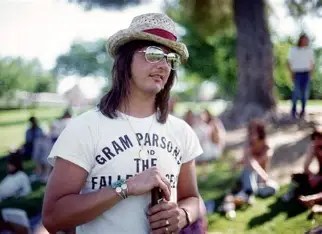
Florida-born Parsons (5/11/1946), experienced an early life that with its instances of domestic drama including alcoholism, wealth (the family owning acres of orange groves) and suicide, read like a Tennessee Williams play. At the age of 21, in the early months of 1968 he was invited to join innovative, hit making L.A. folk-rockers The Byrds, who had recently fired rhythm guitarist David Crosby. Having already attempted a fledgling version of country-pop with a group named The International Submarine Band, Parsons immediately instigated for The Byrds to cut an album of country standards.

Bolstered by two outstanding compositions of his own, the resulting ‘Sweetheart of The Rodeo‘ (August 1968) confused their audience and sold poorly, but many of those who heard the record formed country-rock bands on the strength of it.
His tenure in The Byrds proved so brief he was no longer part of the group when the album appeared, Parsons after his mid-summer exit making plans to form a band that would realise his vision of fusing country, soul and rock.
Enlisting now ex-Byrd Chris Hillman, along with Chris Ethridge and ‘Sneaky’ Pete Kleinow, they formed The Flying Burrito Brothers whose 1969 debut offering ‘The Gilded Palace of Sin‘ was instantly memorable, yet failed to make any significant chart headway.
The follow up ‘Burrito Deluxe‘ (1970) – by which time future Eagle Bernie Leadon had joined the ranks – was less assured, partly due to Parsons waning interest in the group, his rapidly developing friendship with Keith Richards giving him place among the Rolling Stones inner circle. Inclined to spend more time in their company than with his own band-mates, they fired him from the Burritos two months after the second album appeared.
Now completely free to indulge in the hedonism surrounding the Stones (his musical bearing on their creativity apparent in the county-tinged Jagger/Richards composition ‘Wild Horses‘ included on ‘Burrito Deluxe‘), in the summer of 1971 Parsons was a member of their entourage who descended upon a chateau named Nellcote on the Cote de ‘Azur, where initial sessions for what became ‘Exile on Main St.’ occurred.
While ensconced with them in the South of France (where the band had decamped due to their new found status as U.K. tax exiles), it was muted that Richards would produce the solo album Parsons was intending to make. But due to Stones commitments and other well documented distractions affecting them both, nothing came to fruition.
After Parsons returned to Los Angeles country star Merle Haggard expressed interest in producing the album only to have a change of heart when time came to fully commit, the artist by this stage having decided he would make a record featuring female harmony vocals, if he could find a suitable vocalist.
While discussions with Warner Bros at something of an impasse, the label had agreed to release the album but not at the level of finance he was hoping for, (Parsons declaring his intention to work with musicians best known for being Elvis Presley sidemen), plans reached a frustrating standstill, only to be revived by a fortuitous twist of fate.
Singer-songwriter Rick Roberts, who had replaced Parsons in the Burritos, after the group had played a concert one night in that neck of the words, chanced upon an unknown 24-year-old folk singer named Emmylou Harris playing in a Washington club. In turn her number was passed to Hillman and aware of the record Parsons was intending to make, he suggested they meet to find out if she and his former Burrito brother were compatible as singers.
Immediately impressed by her vocal talent as any sane person would be (Alabama-born Harris having a long-forgotten 1970 album for a minor label to her name), Parsons had found his collaborator. But even then there were still hurdles to climb, not least in finding the big name producer Warner Bros were hoping for, first choices Richards and then Haggard rendering themselves either unavailable or unwilling to be involved.
But as things transpired the matter was resolved inadvertently. Receiving an invitation in June 1972 from Ric Grech, (whom he met briefly while in London with The Byrds four years before), to contribute to a country-themed album the former Family, Blind Faith and Traffic bassist had designs on making, while in England the offer was reciprocated. The only difference being that Parsons would see his efforts come to fruition with release of ‘GP‘ (January 1973), while Grech, who co-produced the record with its creator, would not – sessions for his album ending amidst the haze of substance of abuse from several involved, Parsons and Grech included.
On returning to L.A. with a like-minded sole to assist him with production, Parsons found Warner Bros still unwilling to improve the budget allocated to him, but determined to use the revered Presley players he hired James Burton (guitar), Ronnie Tutt (drums) and keyboard player Glen D. Hardin at his own expense – the recording of what became ‘GP‘ taking place at Wally Heider Studios in Hollywood through September and October 1972.
Comprising six originals (two of them co-written) and five covers, Parsons, for the most part, fulfils his ambitions to create contemporary country music. While rock inflections are evident they offer gentle seasoning rather than the full flavour – the true taste being a mix of Nashville influences and his own originality, ‘GP‘ in many respects unlike any album to have come before it.
While male/female duetting in countryfied songs was nothing new, George Jones and Melba Montgomery cutting albums as a duo ten years before, the combination of his often fragile tenor and the lush tones of Harris, who admirably ignores the temptation to over sing, creates an appealing blend, no matter if the song at hand is expressing despair or delight.
Their impressive vocal coordination is instantly to the fore on brisk paced opening track ‘Still Feeling Blue‘, a Parsons-penned song where the downcast lyric (‘The lonely days and lonely nights/I guess the world knows I ain’t feeling right/And when you’re gone the hours pass so slow‘), is not reflected in the jaunty melody.
Decorated by top class contributions from Burton (dobro), fiddle maestro Byron Berline and Alan Munde (banjo), the narrator is resigned to accepting the situation even though his hurt, (‘I hope you’re out and happy now/Doing up the town ’cause you know how/Every time I hear your name I want to die‘), shows no sign of dissipating anytime soon.

Fueled by fiddle incisions and crisp pedal steel guitar lines of one-time Burrito brother Al Perkins – who at that time was a member of Stills’ ‘Manassas’ ensemble – ‘How Much I’ve Lied‘, co-written with L.A. session guitarist David Rifkin, finds Parsons confessing directly to the lover, (‘And I don’t know just what’s right or wrong/To take a chance on losing you was such a silly thing to do‘), he has betrayed.
With support from Harris kept to a minimum, the song in not containing a chorus reads as a lament of deep regret, the writer capturing the full extent of his remorse in the poignant couplet, ‘So one like you should surely be miles and miles away from me/Then you’d never care how much I’ve lied‘.
Built upon the sombre electric piano chords of Hardin, the achingly tender ‘The New Soft Shoe‘ is a ballad that reflects on the passage of time and those left behind by technological change.
Consisting of memories and personal observation (‘And then walking through a Southern mall/I saw a shoeshine stand/A man was talking to a crowd/Holding slippers in his hands‘), Parsons, aided only by Harris at the chorus (which is the title sung twice), sounds disillusioned at how the years have unfolded, his plaintive vocal adding to the resonance.
In contrast ‘Big Mouth Blues‘ that closes the record is a wry, up tempo affair, Parsons having fun at his own expense in admitting being prone to talking too much or saying the wrong thing.
Reminiscent in structure to ‘Older Guys‘ from ‘Burrito Deluxe‘, he acknowledges the trait with the opening line (‘Well, I was born in a little bitty tar hut/And they called me a man ’cause I couldn’t/Keep my big, big mouth shut‘), the song extended to almost four minutes by a fiery Burton guitar solo.
While the track never retreats from upbeat country rock territory, the lyric, even when referencing others, (Well, I once knew a man who sailed around the world twice/He would have made it three/But he took a lot of bad advice‘), has an overriding theme of people bringing trouble upon themselves through ill-chosen words.
Written in conjunction with former Burrito cohort Ethridge, ‘She‘ comes with the country-soul stylings the pair created on ‘Hot Burrito #1′ a magnificent song they wrote together for ‘The Gilded Palace of Sin’.
In essence a tribute to an unnamed woman from the South blessed with an unforgettable singing voice, the words conjure the land into which she was born, (‘She, she came from the land of the cotton/A land that was nearly forgotten by everyone’), her remarkable talent as a singer, but most of all belief in a higher power and the shared joy of sending praise up to the heavens:
‘She had faith, she had believing/She led all the people together in singing/And she prays every night to the Lord up above/Singing, “Hallelujah“.
Accompanied by Hardin on piano, sympathetic pedal steel guitar and mournful fiddle playing from Berline, the brittle tone of his vocal delivery works to the advantage of a sumptuous offering that loses nothing in authenticity for excelling in sheer songcraft.
Parsons is also heard to striking effect on the breathtaking ‘A Song for You‘ whose framework is closer to folk than country. While the melodic structure could be envisaged as the work of a superior L.A-based singer-songwriter, very few among the fraternity could summon up five minutes of equally vivid expressionism.
Set against a haunting pedal steel guitar refrain, the meaning of one or two lines in the lyric is hard to pin down with any true certainty, but broadly speaking the song is a plea for acceptance, not necessarily for himself more those who feel adrift in life, ‘Some of my friends don’t know who they belong to/Some can’t get a single thing to work inside.’
While Harris joins him for the chorus, the verses Parsons sings alone, his quivering delivery full of sadness as he reaches a point where moving on will leave behind pain and sorrowful contemplation:
‘I loved you every day and now I’m leaving/And I can see the sorrow in your eyes/I hope you know a lot more than you’re believing/Just so the sun don’t hurt you when you cry.’
While by no means a concept album there is also a sense, admittedly a loose one, of characters having lost their bearings in the five songs he chooses to cover.
The instantly engaging ‘Streets of Baltimore‘, a 1966 country hit for Bobby Bare, tells the story of a man who accedes to the wish of his wife in leaving their Tennessee home for the big city. While she is smitten with urban living, particularly the night life, the husband is less enamored, the vocals of Parsons and Harris showing no hint of irony when things sour to such degree he is left with only one option:
‘Well I did my best to bring her back to what she used to be/Then I soon learned she loved those bright lights more than she loved me/Now I’m going back on that same train that brought me here before/While my baby walks the streets of Baltimore.’
Side two opener ‘That’s All It Took’ which had been recorded by George Jones in 1964, finds Harris and Parsons trading vocal lines in propelling this energetic country waltz, both singers excelling in their roles of a spurned lover (‘I tell my friends I’m happy/But they read me like a book‘), unable to find any solace.
Written by co-producer Grech, presumably for the country L.P. he had designs on making, ‘Kiss the Children‘ is a disconcerting account of how the central figure has been trapped by bad choices of the past. Parsons needless to say, sounding right at home with the subject matter.
Using a traditional country format of pedal steel guitar and fiddle, the singer makes no secret of the wayward person he is, (‘Cause I’ve spent a lot of time down on the corner/Tasting tears and spilling whiskey on the floor‘). Appalled at the self-destructive ways that define him and how they impact on his family, he ponders a stark solution, ‘Cause I won’t be able to resist my rage/And the gun that’s hanging on the kitchen wall, dear/Is like a road sign pointing straight to Satan’s cage.’
That Grech (born in France, but raised in England), could write a piece so nuanced is testament to his understanding of country music sensibilities and vindicates the decision of Parsons to have him at hand when recording the record.
Drawn from the unexpected source of Detroit rockers the J.Geils Band, ‘Cry One More Time‘ (written by frontman Peter Wolf and keyboard player Seth Justman) receives a country-swing makeover.
Adding a baritone saxophone and honky tonk piano for good measure, the rendition is closer in feel to New Orleans than Nashville making the Fats Domino affectations impossible to miss, Parsons delivering regretful couplets such as, ‘So sad to be alone at night/So sad it didn’t work out right‘ over a bedrock of country-honed R & B.
There is no shortage of yearning either in the majestic ‘We’ll Sweep Out The Ashes in the Morning‘ where Harris and Parsons assume the parts of clandestine lovers in a song written in 1969 by Nashville-based Joyce Allsup.
The illicit nature of the relationship is explained (‘We know it’s wrong to let this fire burn between us/We’ve got to stop this wild desire in you and in me‘) in the opening lines, the picture going on to be decorated by formidable dobro playing from Burton.
Sequenced as the second track, the third verse is where Harris truly announces herself as vocalist par excellence. The microphone is hers alone as she asserts why Parsons chose her to sing with – and how in time the record buying public would find her voice irresistible:
‘Each time when we meet, we both agree it’s for the last time/But out of your arms, I’m out of my mind.’
Given the lyrical connotations of the track there came speculation Parsons (who was married at time) and Harris became lovers on the tour in support of the album, when they were backed by a band dubbed The Fallen Angels.
This was always strenuously denied by both his soon-to-be-widow Gretchen and Harris – whose bond with Parsons was seemingly one of artistic virtue, but there is no denying the profound connection between them when singing together.
Despite the undoubted high standard of ‘GP‘ it made no chart impact whatsoever, not even an encouraging review in Rolling Stone or lengthy run of shows with The Fallen Angels able to generate enough momentum for it to reach the U.S. Top 200.
That said, the tour was a series of highlights and haphazard performances. The time they were joined on stage by Neil Young and Linda Ronstadt now the stuff of legend opposed to Parsons often performing drunk, escapades whilst under the influence resulting in two nights spent in jail along the way.
In the late summer of 1973 Parsons assembled many of the ‘GP‘ crew (his preferred studio musicians and the road band two different entities), to begin work on a follow up and with Warner Bros again offering minimal financial support he picked up many of the bills, the support cast now extended to include Ronstadt and Leadon.
Within a couple of weeks they had cut the tracks that would constitute ‘Grievous Angel‘, which like its predecessor was a work of notable accomplishment. Sadly, however, ‘GP‘ would prove the last album he would release in his lifetime, Parsons dying of a drug overdose at the Joshua Tree Inn, California at the age of just 26 on Wednesday 19 September 1973.
When ‘Grievous Angel‘ was posthumously released in January 1974 it barely created a ripple, although those aware of his pioneering ways described him as a ‘visionary’ in their tributes. In death there would be no riding the coattails of country-rock popularity for Parsons, (later that year the Eagles scored their first number one with ‘Best of My Love‘, a song with distinct country leanings), his legacy not fully acknowledged until arrival of the alternative-country scene two decades later, ‘GP‘ regarded as a touchstone for this new wave of artists.
Crafting the resonant, inspirational music he did in such a short space of time adds to his mythology, yet with it comes deep frustration that Gram Parsons did not live far longer to create much more.
GRAM PARSONS – GP (Released January 26 1973):
Still Feeling Blue/We’ll Sweep Out the Ashes in the Morning/A Song for You/Streets of Baltimore/She/That’s All It Took/The New Soft Shoe/Kiss the Children/Cry One More Time/How Much I’ve Lied/Big Mouth Blues;
Hello – hope you enjoyed another exclusive production from SAMTIMONIOUS.com
In order to create the best experience for when you drop by to read a page or two, those with the power to ordain such things (me, actually), have decided to remove all external advertising from the site – in other words articles will no longer be subject to intrusive pop-up ads. BUT – and ain’t there always one – should you wish to make a donation toward the on-costs of the most entertaining and original blog-site around, please press on the – ‘DONATE’ – button below. It will be greatly appreciated.
Stay safe everyone and thanks for dropping by – best wishes Neil
SAMTIMONIOUS.com – films, football and fabulous music at The Dominion of Opinion
NEIL SAMBROOK is also the author of MONTY’S DOUBLE – an acclaimed thriller available in paperback and as an Ammazon Kindle book: